
Background
Darling is Sean Brock’s first restaurant on the West Coast: heritage Southern cooking over a live fire, paired with an all-vinyl hi-fi lounge, in the heart of West Hollywood. Brock is one of the most decorated chefs in America. A James Beard Award winner, the subject of his own episode of Netflix’s Chef’s Table, and a familiar face from The Mind of a Chef, Anthony Bourdain’s Parts Unknown, and Top Chef.
The restaurant earned glowing press from the Los Angeles Times, Eater, and Forbes the moment it opened. The digital foundation underneath it had not caught up.
The Challenge
The website is the front door of a restaurant, and this one was working against the room:
- The site opened on a brunch promo, not the story. A template homepage led with a seasonal announcement instead of the chef, the fire, or the reservation.
- Menus lived inside PDFs. Search engines and AI assistants could not read a single dish.
- Zero measurement. No Google Analytics, no ad pixels, no way to connect marketing effort to reservations or revenue.
- Slow on the devices that matter. Diners decide on their phones. The mobile experience took over ten seconds to show its most important content.
- No paid demand engine. One of the country’s most famous chefs had no presence in paid search or paid social in his own neighborhood.
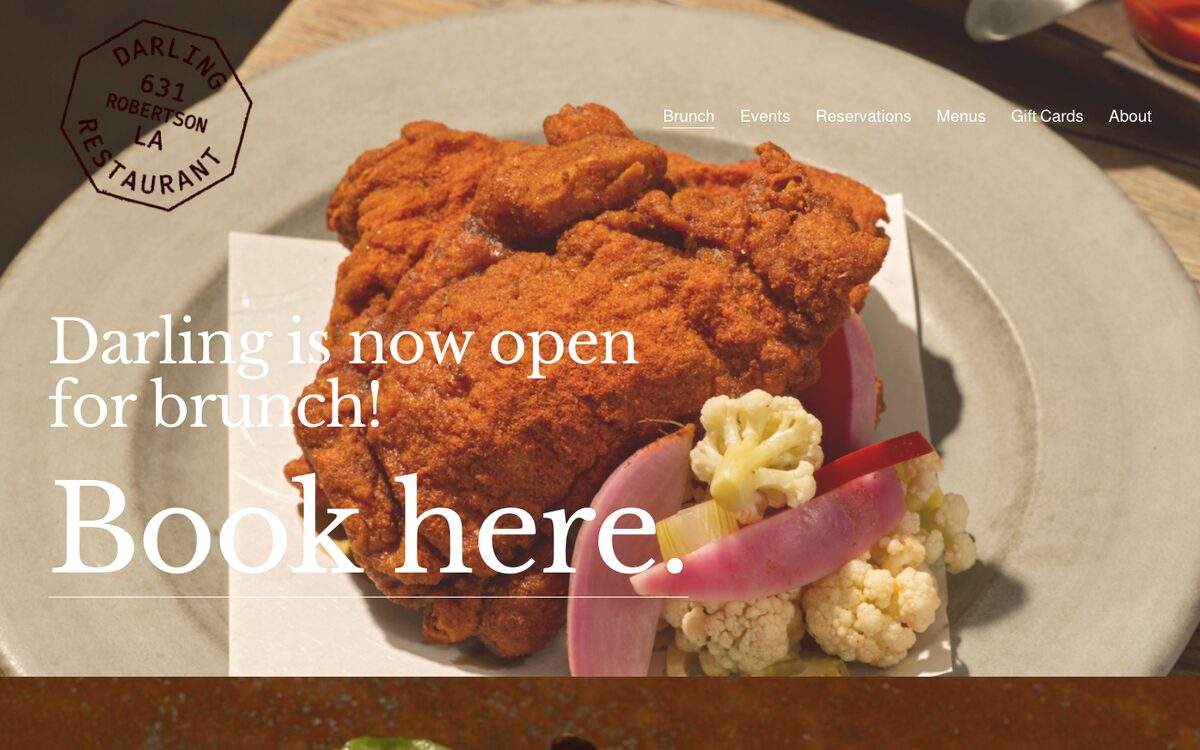
Before: a template site that opened on a brunch promo, with PDF menus and no analytics.
The Strategy
Rebuild the foundation first, then turn on demand. The whole system points at one action: the reservation.
A ground-up custom site, benchmarked against the best
Custom HTML, CSS, and JavaScript on Cloudflare Pages, no template. The design brief ranked fifteen of the best restaurant sites in the country as inspiration and set a simple hierarchy: reservation first, then menu, hours, and map, all findable without thinking. Cinematic photography and film carry the ambiance; the chef’s story and the press carry the authority.
Menus the whole internet can read
Every menu rebuilt as crawlable HTML with structured data, so Google and AI assistants can read every dish. The same pages print as the in-house menus, so one edit updates the site and the printed card together.
Measurement from day one
GA4 and the Meta pixel installed with a purpose-built reservation click event, wired to Resy. For the first time, every channel’s contribution to the reservation book is visible week over week.
A measured paid media launch
Google Ads and Meta Ads launched on modest budgets and stepped up only as the data earned it. Weekly optimization rounds tune keywords, creative, and budgets against actual covers and revenue, not vanity metrics.
Speed as a ranking and conversion lever
Responsive images, self-hosted fonts, and a mobile-first media strategy took the key mobile load milestone from 10.2 seconds to 2.6 and cut page weight from 9MB to 2.2MB, with no visual compromise.
The Results
Five weeks after the paid program launched on the new site, Darling posted its record week: $34,772 in weekly restaurant sales on 492 covers, against $18,490 on 310 covers in the week before launch. Revenue per cover rose from $59.65 to $70.68 over the same window.
The growth built week over week rather than spiking, exactly what a measured budget staircase is designed to do:
| Week | Restaurant sales | Covers | Reservation clicks |
|---|---|---|---|
| Pre-launch | $18,490 | 310 | 156 |
| Round 1 | $23,180 | 344 | 189 |
| Round 2 | $23,835 | 319 | 216 |
| Round 3 | $28,695 | 405 | 262 |
| Round 4 | $34,772 | 492 | 294 |
Weekly restaurant trade from the point-of-sale system, excluding private event deposits. Reservation clicks measured on the site in GA4.
Why It Works for Any Restaurant
The Darling playbook applies to any restaurant or hospitality brand where the reservation is the business:
- The site has one job. Reservation, menu, hours, map. If a first-time visitor has to think, the site is losing covers.
- Menus belong in HTML. Diners, Google, and AI assistants all read the same pages. PDFs are invisible to two of the three.
- Measure before you spend. A reservation click event by channel turns ad budgets from a leap of faith into a weekly tuning exercise.
- Step budgets up, never jump. A staircase reveals what each dollar buys and protects efficiency as spend grows.
- Speed is revenue. Diners decide on their phones, often standing on the sidewalk. Every second of load time costs covers.
Who Did What
What we did
- Rebuilt the website from the ground up in custom code on Cloudflare Pages, reservation first, menus in crawlable HTML.
- Installed GA4 and the Meta pixel with a reservation click event wired to Resy.
- Launched Google Ads and Meta Ads on modest budgets and stepped them up as the data earned it.
- Cut the key mobile load milestone from 10.2 seconds to 2.6 and page weight from 9MB to 2.2MB.
- Ran weekly optimization rounds against covers and revenue.
What the client did
- Ran the room: 492 covers in the record week, up from 310.
- Supplied the restaurant’s own footage that the hero film and the Meta creative were cut from.
- Shared Toast point-of-sale and Resy data so every round was judged on covers and dollars.
- Took $17,950 in private event deposits in the record week on top of restaurant trade.
Conclusion
Darling went from a template site with no measurement to a fast, reservation-first foundation with a measured demand engine on top, and posted its record week five weeks later: weekly restaurant sales up 88%, covers up 59%, and revenue per cover up 18%. The same sequence, foundation first, measurement second, demand third, is what Noble Growth brings to every hospitality brand we work with.